TDP

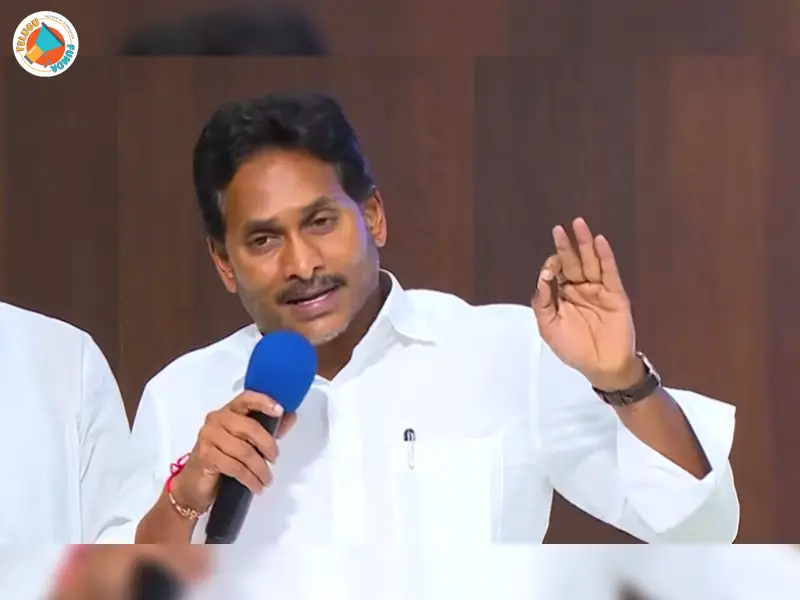
Andhra Pradesh is witnessing a fresh political battle over credit as the first phase of the historic Veligonda Project is set to be inaugurated by Chief Minister N. Chandrababu Naidu on Monday. While the coalition government is presenting the project as a major irrigation milestone, former Chief Minister YS Jagan Mohan Reddy has claimed that the credit for its completion largely belongs to his father, the late YS Rajasekhara Reddy, and his YSR Congress Party government.

Jagan Claims Credit for Veligonda Project

Jagan took to X with a detailed post highlighting the history of the Veligonda project and seeking to attribute much of its progress to successive YSR-led governments.

He pointed out that the project was originally conceived decades ago and alleged that despite the foundation stone being laid during Chandrababu Naidu’s earlier tenure in 1996, significant progress remained limited for several years.

According to Jagan, the Jala Yagnam initiative launched during YS Rajasekhara Reddy’s tenure played a crucial role in developing the project’s core infrastructure, including dams, canals and the twin underground tunnels.

Jagan Highlights Final Tunnel Work

Jagan also claimed credit for his own government, stating that it undertook one of the most challenging remaining components of the project the excavation of the final 10.5 kilometres of the twin tunnels.

He argued that these works were crucial to bringing the long-pending project closer to completion and questioned the coalition government’s claims surrounding the project.

R&R Issue Becomes Another Flashpoint

The former Chief Minister also criticised the Chandrababu Naidu-led government over the Rehabilitation and Resettlement (R&R) process.

Jagan alleged that the government had failed to adequately address the concerns of displaced villagers for more than two years, leaving some families waiting for compensation. He accused the ruling alliance of focusing on publicity while seeking credit for a project developed over multiple governments.

Chandrababu Government Pushes Project Towards Finish Line

The ruling coalition, however, maintains that its government played a critical role in removing the remaining hurdles and taking the Veligonda project towards completion.

In recent months, the government has reportedly invested more than ₹2,400 crore on essential works, including feeder canals, head regulators and canal lining.

The administration has also focused on clearing long-pending R&R packages, with compensation being disbursed to displaced families. The government has positioned these measures as essential steps to enable the reservoir to be filled while addressing the concerns of affected communities.

Veligonda Project Turns Into Political Credit Battle

The Veligonda Project is now more than an irrigation milestone it has become another major political credit battle between the TDP-led coalition and YSRCP.

With Chandrababu Naidu set to inaugurate the first phase, the coalition government is highlighting the expenditure and final-stage works completed under its tenure, while Jagan is stressing the contributions of YS Rajasekhara Reddy and his own administration.

The project is expected to provide drinking water to fluoride-affected villages and support irrigation across thousands of acres in the drought-prone regions of Prakasam, Markapuram, Nellore and Kadapa, making its completion politically and economically significant for Andhra Pradesh.

Follow Telugu Funda on trending Social Media Platforms for more Cinema, OTT, Political, And Sports updates.
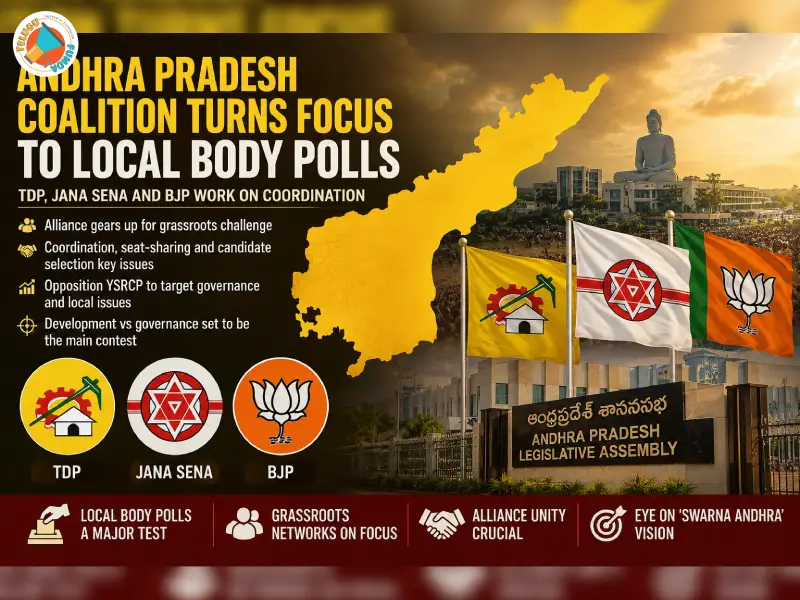
Amaravati: The ruling alliance in Andhra Pradesh, comprising the Telugu Desam Party (TDP), Jana Sena Party and Bharatiya Janata Party (BJP), is shifting its political focus towards the upcoming local body elections, with coordination among the three partners emerging as a key priority.

The alliance, which came to power in the 2024 Assembly elections with the TDP as the principal partner, is now looking to extend its electoral understanding to the grassroots level. The local body polls are expected to test not only the alliance’s popularity but also its organisational coordination across villages, mandals, municipalities and urban local bodies.

For the coalition partners, the elections will be important in strengthening their grassroots networks and establishing local leadership ahead of future political contests. However, managing differences among party cadres and local leaders could prove to be a major challenge.

BJP leader P V N Madhav recently acknowledged that there was some dissatisfaction among cadres of the TDP, Jana Sena and BJP. He stressed the need to address such concerns and improve coordination before the local elections.

The issue is significant because political competition at the local level can be more complicated than in Assembly elections. While the three parties may remain alliance partners at the state level, their local leaders could have competing political ambitions and support bases.

Candidate selection and seat-sharing are therefore expected to become crucial issues. The alliance may have to work out arrangements at the village, mandal and municipal levels to avoid direct contests between leaders belonging to different coalition partners.

The TDP remains the largest partner with a broad organisational presence across the state. Jana Sena has its own support base under the leadership of Deputy Chief Minister Pawan Kalyan, while the BJP brings its national political presence and organisational network to the alliance.

The local elections could consequently become an important opportunity for each party to assess its independent organisational strength while maintaining the broader coalition arrangement.

The YSR Congress Party (YSRCP), meanwhile, is expected to closely monitor developments within the ruling alliance and target the government over governance and local issues. Former Chief Minister YS Jagan Mohan Reddy has continued to raise concerns over issues including recruitment, drought relief and welfare implementation.

Recruitment controversies, including allegations surrounding DSC and Group I processes, could also feature in the Opposition’s campaign. Jagan has sought a CBI investigation into the alleged irregularities, while the government and its leaders have rejected the Opposition’s allegations.

At the same time, the TDP-led government is likely to highlight its development agenda. Amaravati remains a major focus, with the government pushing infrastructure projects and investment initiatives as part of its broader plans for Andhra Pradesh.

The coalition is also seeking to promote its long-term development vision under the broader ‘Swarna Andhra’ agenda. The local elections could therefore develop into a contest between the government’s development narrative and the Opposition’s criticism of governance.

Maintaining unity within the alliance will be particularly important as the political contest moves from the statewide level to smaller constituencies. Local rivalries, leadership ambitions and differences over candidate selection could put pressure on the partnership.

For the ruling parties, a coordinated performance in the local body elections could strengthen the alliance’s grassroots presence and reinforce the mandate secured in the 2024 Assembly elections. Any visible differences, however, could provide the Opposition with an opportunity to challenge the coalition.

As preparations gather pace, discussions among TDP, Jana Sena and BJP leaders are likely to centre on seat adjustments, candidate selection, cadre coordination and campaign strategy.

The upcoming local body elections are thus set to become an important test of not only the ruling alliance’s electoral strength but also its ability to maintain political unity at the grassroots level.

Follow Telugu Funda on trending Social Media Platforms for more Cinema, OTT, Political, And Sports updates.

Recent Posts

Categories